If you’ve ever glanced in the mirror and thought, “Where did that little hump at the base of my neck come from?” — you are so not alone.
Many of us in midlife start to notice rounding through the upper back or a forward head posture that just wasn’t there in our 30s. It’s often called kyphosis or Dowager’s Hump, and while it can feel discouraging, here’s the good news:
- You are not stuck with it.
- You didn’t “fail” at posture — your body simply adapted to how you use it.
As a 35+ year trainer and certified Pilates instructor, I’ve coached thousands of women through this. Strengthening the upper back — from the cervical vertebrae in your neck through the thoracic spine (mid-back) — is one of the biggest game changers for posture, confidence, and long-term mobility.
Let’s break this down in a way that feels empowering and understandable.
What Exactly Is Kyphosis?
Kyphosis refers to an exaggerated forward curve in the upper spine. Everyone has a natural curve — that’s normal and healthy. But when the thoracic spine rounds too much, it can become what many call a “hump.”
While genetics and structural issues can play a role, most midlife women experience postural kyphosis, meaning it’s functional and influenced by:
- Lifestyle habits
- Muscle imbalances
- Daily movement patterns
The good news? Postural kyphosis is highly responsive to movement.
Spine Anatomy (In Simple Terms)
Your spine isn’t one long stick. It’s made up of 24 movable vertebrae, each designed to articulate and share load.
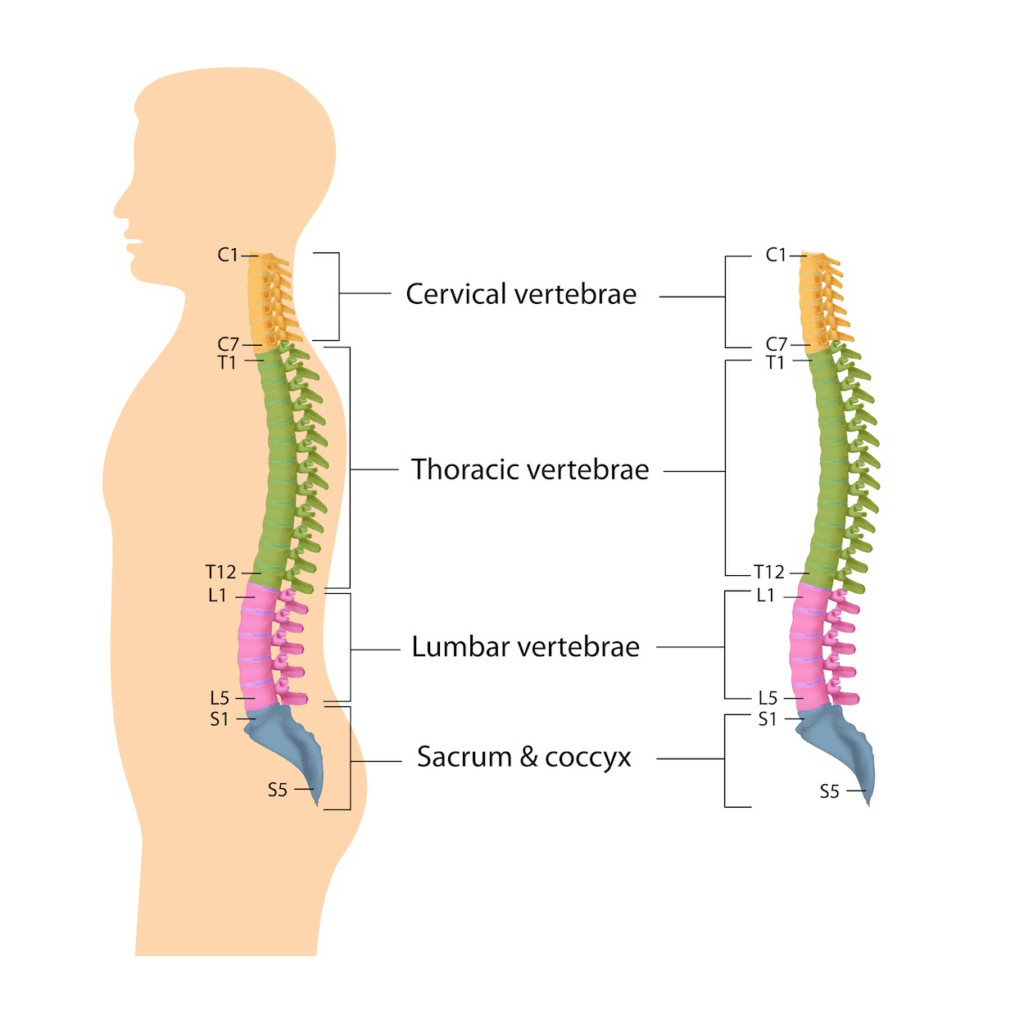
- Cervical spine (neck): 7 vertebrae that control head position
- Thoracic spine (upper/mid back): 12 vertebrae that anchor the ribs and support posture
- Lumbar spine (low back): 5 vertebrae built for stability and load-bearing
A healthy spine forms gentle curves that act like springs.
But sitting, slouching, screen time, stress, and age-related changes can exaggerate the thoracic curve while shifting the cervical spine forward.
The result?
- Forward head posture
- Rounded shoulders
- Weak upper-back muscles
- A visible “hump” or fullness at the base of the neck
Why Midlife Women Are Especially Prone to Kyphosis
Kyphosis in middle age is not about blame — it’s about biology, lifestyle, and knowing what we’re up against so we can take action.
Hormonal Changes + Bone Density Shifts
After menopause, bone density naturally declines and disc height can decrease. This makes it easier for the upper back to collapse forward.
A Lifetime of “Forward Living”
Think about how much of life happens in front of you. The term “tech neck” has become increasingly popular and more people are noticing the outcome of spending time on:
Your body adapts to its most repeated position.
Weak Upper Back + Tight Chest
This classic imbalance in middle age women presents as:
- Tight chest muscles
- Weak upper-back muscles
- Head drifting forward
- Shoulders rounding
- Spine following
Sedentary Time Adds Up
Women today sit more than ever. Prolonged sitting — especially unsupported — is directly correlated with progression of postural kyphosis.
That’s why I’ve personally added a walking pad to my workday routine. More time on my feet, and less time bent over my computer in a chair!
Stress and Breathing Patterns
Shallow breathing tightens the chest and collapses the spine forward. Posture and breath are deeply connected.
What Happens If You Ignore Kyphosis?
Not to scare you — but to inspire action — here’s what can happen if kyphosis progresses:
- Increased neck, shoulder, and upper-back pain
- Stiffness and reduced mobility
- Tension headaches
- Limited thoracic extension (harder to stand tall)
- Reduced lung capacity in severe cases
- Decreased confidence (posture absolutely affects mood and self-image)
Important reminder: Posture can improve at any age. I’ve seen women in their 70s make incredible changes.
The Real Cause: Poor Upper-Back Muscle Control
This is where Pilates taught me so much.
Posture is not just about “pulling your shoulders back.” That often creates tension. The real issue is weak or under-used muscles deep between the shoulder blades and along the spine, including:
- Rhomboids
- Mid and lower trapezius
- Spinal extensors
- Scapular stabilizers
When these muscles aren’t activated regularly, the front body takes over and pulls you into rounding.
Add a forward-thrusting head (which weighs 8–12 pounds — thanks, Jerry Maguire 😉), and the body adapts by building soft tissue at the base of the neck for stability.
What Research Shows: Yes, Kyphosis Can Improve
If your kyphosis is postural — which is true for most midlife women — improvement is absolutely possible.
Research shows:
- Strengthening upper-back muscles reduces rounding
- Thoracic mobility improves extension
- Stretching the chest increases spinal freedom
- Strength + mobility together work better than stretching alone
The Best Exercises to Improve Kyphosis (Pilates-Inspired & Midlife-Friendly)
Strength + mobility + awareness = your recipe for a taller, healthier spine.
Improving kyphosis isn’t about forcing yourself to “stand up straight.” It’s about:
- Restoring mobility in the upper spine
- Strengthening postural muscles
- Building awareness you carry into daily life
These exercises are gentle, effective, and perfect for midlife women. No fancy equipment required.
Remember, consistency beats intensity. Doing 5–10 minutes daily helps far more than one intense session per week.
👉 Move slowly, breathe deeply, and focus on quality over quantity.
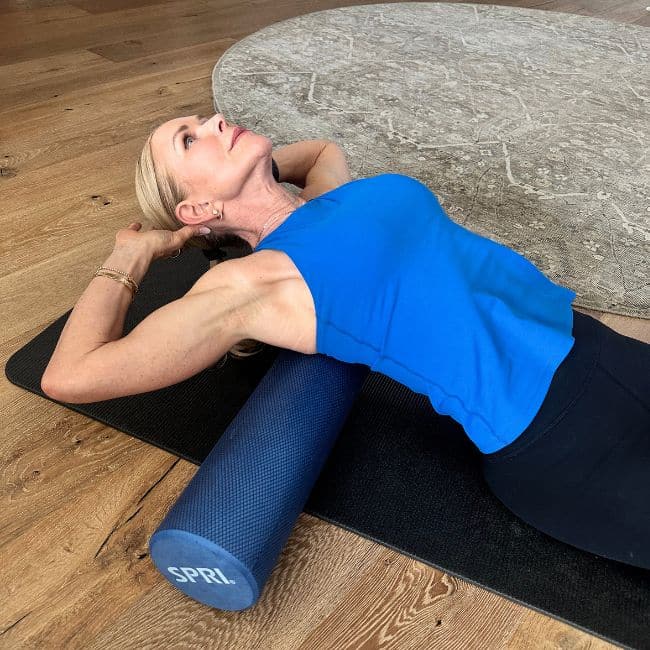
1. Foam Roller Thoracic Extension
Why it helps:
This is one of my favorite exercises for kyphosis. It helps restore extension in the thoracic spine- an area that often gets stiff from sitting and slouching.
How to do it:
- Place a foam roller horizontally on the floor.
- Lie on your back with the roller under your upper back (mid-back area).
- Support your head with your hands.
- Gently extend your upper back over the roller – no crunching, no forcing.
- Pause briefly, then return to neutral.
Reps: 10–15 slow reps
Coaching cue:
“Think length, not how far you bend.”
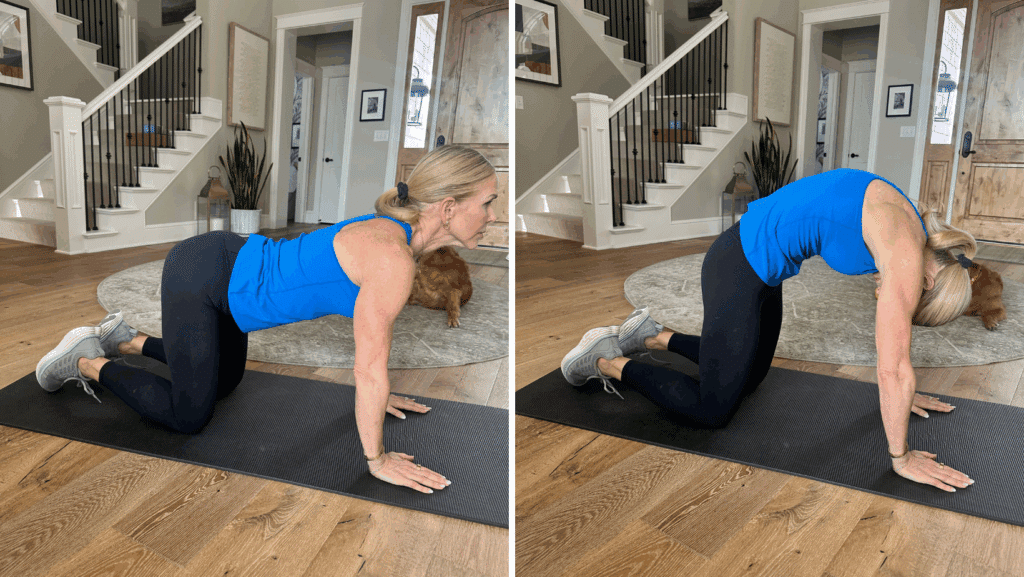
2. Cat–Cow Stretch
Why it helps:
This move mobilizes every vertebra in your spine and helps reconnect your neck, upper back, and core.
How to do it:
- Start on hands and knees in a tabletop position.
- Inhale as you arch your spine, lift your chest, and gently look forward (Cow).
- Exhale as you round your back, draw your belly in, and let your head relax (Cat).
Reps: 10–15 slow cycles
Coaching cue:
“Move one vertebra at a time -slow and controlled.”
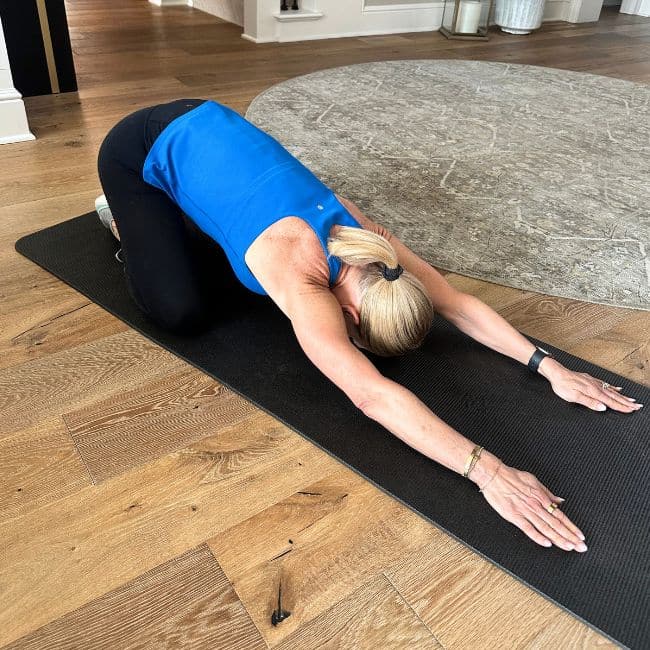
3. Child’s Pose
Why it helps:
A wonderful stretch for the upper back, shoulders, and spine and a chance to breathe deeply.
How to do it:
- Start on hands and knees.
- Sit your hips back toward your heels.
- Reach your arms forward and lower your chest toward the floor.
- Relax your neck and breathe.
Hold: 20–30 seconds
Repeat: 3 times
Coaching cue:
“Let your breath soften your upper back.”
4. Cobra Stretch (Gentle Back Extension)
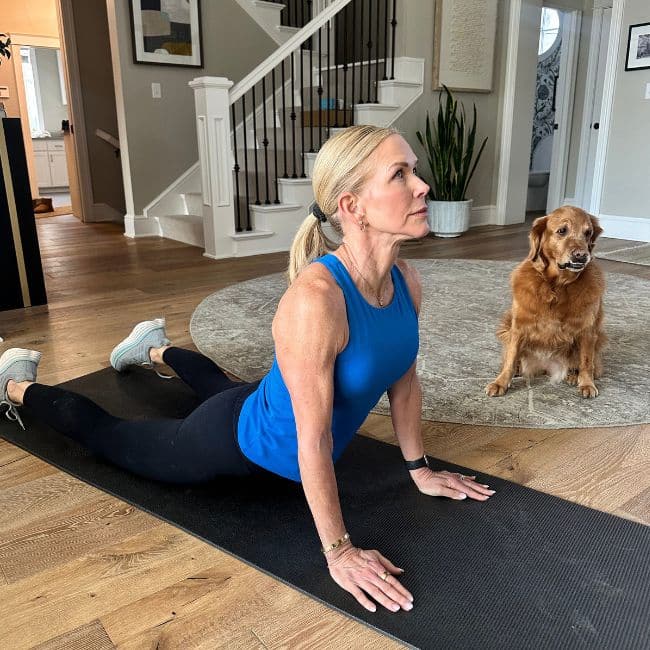
Why it helps:
This opens the chest and encourages spinal extension – key for countering rounded posture.
How to do it:
- Lie face down with hands under your shoulders.
- Press gently into your hands to lift your chest.
- Keep elbows slightly bent and shoulders relaxed.
- No locking, no forcing.
Hold: 20–30 seconds
Repeat: 3 times
Coaching cue:
“Lift your chest forward and up -not straight back.”
5. Scapular Squeezes
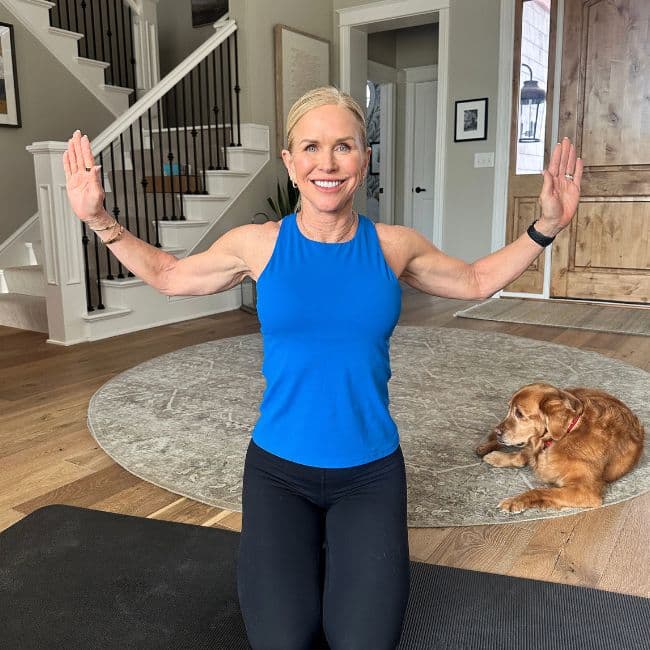
Why it helps:
Strengthens the muscles between your shoulder blades – essential for upright posture.
How to do it:
- Sit or stand tall with arms in goal post position
- Gently squeeze your shoulder blades together and slightly down.
- Hold briefly, then relax.
Reps: 10–15 reps
Coaching cue:
“Imagine sliding your shoulder blades into your back pockets.”
6. Prone Y, T, and I Raises
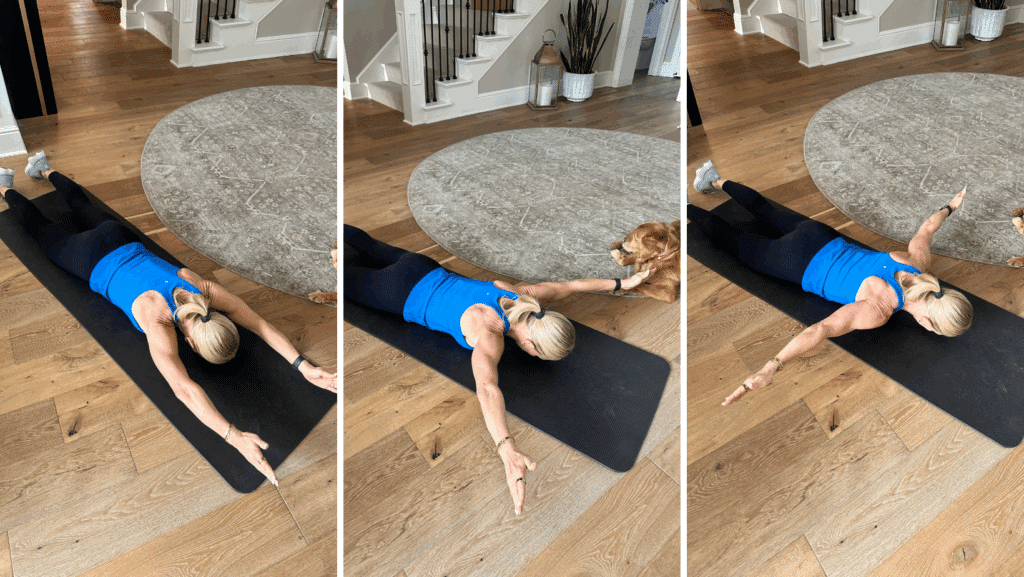
Why it helps:
This series strengthens the upper back and improves shoulder stability – two big posture helpers.
How to do it:
- Lie face down on the floor or mat.
- Arms extended overhead in a Y shape -lift arms slightly, squeeze shoulder blades.
- Lower and repeat with arms in a T shape (out to the sides).
- Then repeat with arms in an I shape (along your sides).
Reps: 10–15 reps per position
Coaching cue:
“Lift from your upper back, not your neck.”
7. Wall Angels
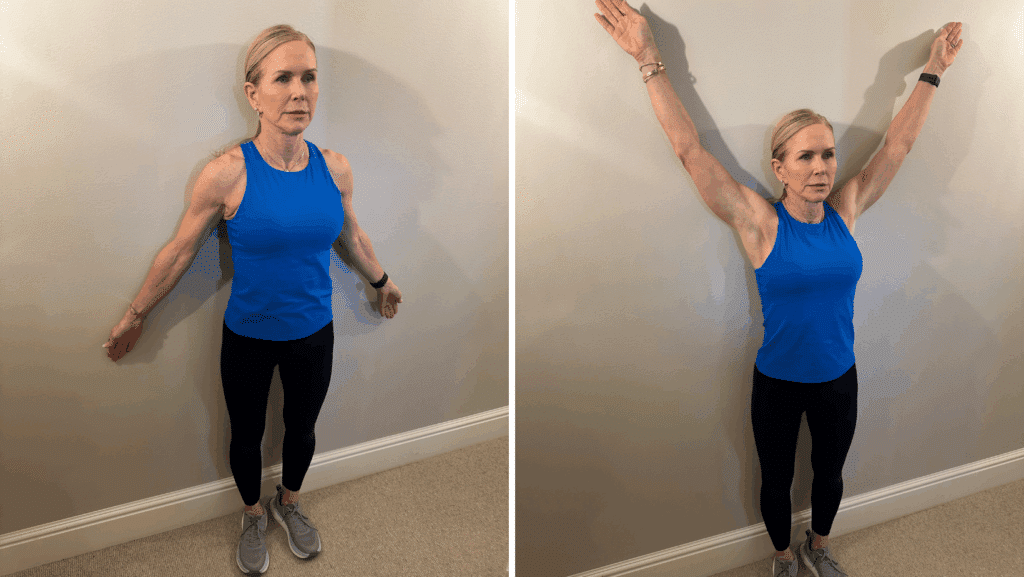
Why it helps:
This teaches your body what good posture feels like while strengthening the upper back.
How to do it:
- Stand with your back against a wall, feet a few inches away.
- Press your head, upper back, and hips gently into the wall.
- Bring arms up and down like you are drawing the wings of an angel.
Reps: 10–15 reps
Coaching cue:
“Keep ribs relaxed -no arching your low back.”
8. Side-Lying Thoracic Rotation (Open Book)
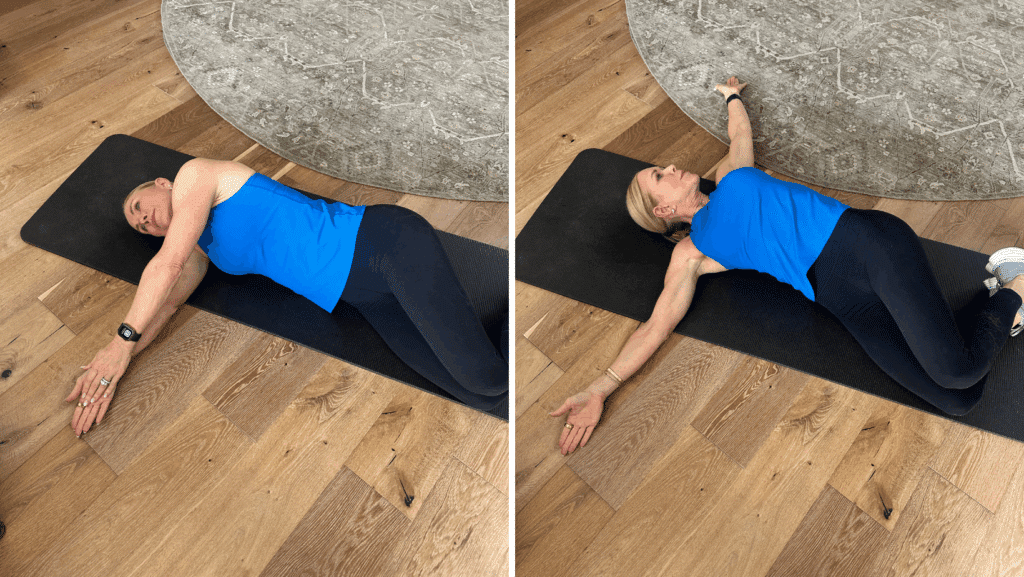
Why it helps:
This restores rotation and mobility in the thoracic spine often stiff in women with kyphosis.
How to do it:
- Lie on your side with knees bent and arms stacked in front of you.
- Slowly open your top arm across your body, rotating your ribcage.
- Keep knees stacked and hips still.
- Return slowly.
Reps: 5–8 reps per side
Coaching cue:
“Let your ribs rotate – not your low back.”
9. Plank (or Knees Down)
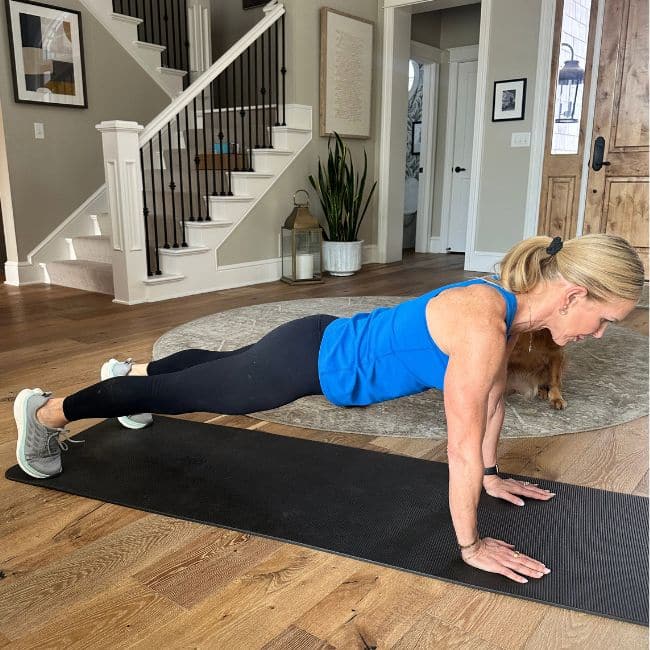
Why it helps:
A strong core supports a tall spine. Planks help reinforce alignment from head to heels.
How to do it:
- Start in a push-up position (knees down is perfect).
- Hands under shoulders, neck long, core engaged.
- Hold while breathing.
Hold: 20–30 seconds
Repeat: 2–3 times
Coaching cue:
“Long spine – no sagging, no lifting.”
10. Chin Tucks (Cervical Retraction)
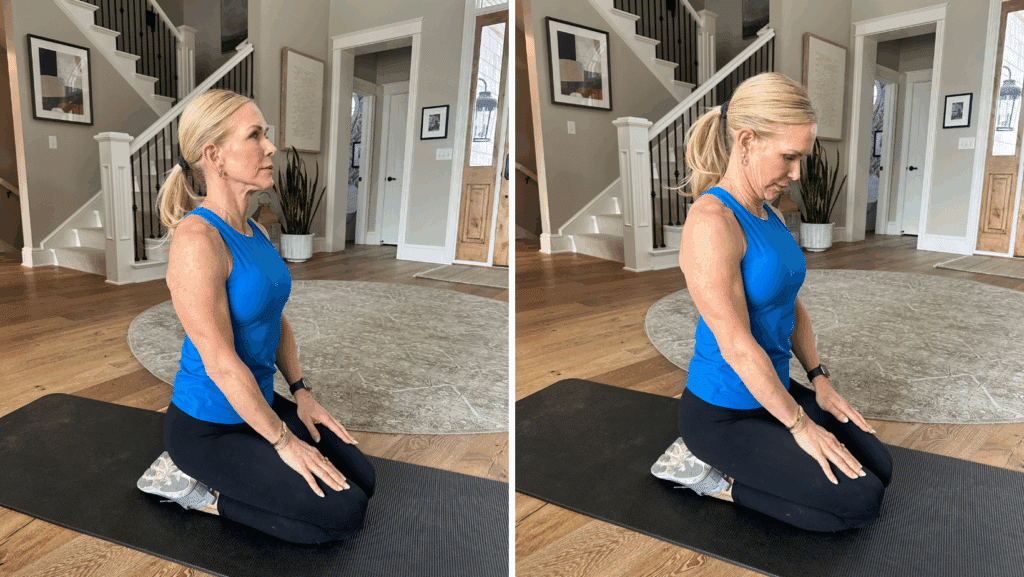
Why it helps:
Helps correct forward head posture and supports the cervical spine.
How to do it:
- Sit or stand tall.
- Gently draw your head straight back (as if making a double chin).
- Hold briefly, then release.
Reps: 10–15 reps
What to Avoid If You Have Kyphosis
- Only stretching without strengthening
- Heavy forward-flexion (crunch-heavy routines)
- Slouching for long periods
- Ignoring the neck–upper back connection
When to Seek Professional Guidance
If pain is severe, posture worsens rapidly, or you suspect a structural issue (like compression fractures), consult:
- A physical therapist
- Your physician
- A qualified Pilates instructor with posture expertise
The Bottom Line: You Can Improve This — At Any Age
After coaching women for over 35 years, here’s what I know for sure:
- Your spine is adaptable.
- Your posture is not “set.”
- Small, daily habits add up.
You don’t need perfection. You need awareness, gentle strengthening, mobility — and a whole lot of compassion for your amazing, aging body.
Stand tall today, even for a moment.
Your body is listening.
