Every five years, the federal government releases updated dietary guidelines for Americans based on the latest available evidence. These guidelines shape national nutrition policy, school meal programs, public health initiatives, healthcare recommendations, and food assistance programs across the country.
The new 2025-2030 Dietary Guidelines for Americans introduce what the report calls a “significant reset” in federal nutrition policy, with a clear and direct message: prioritize real, nutrient-dense food and significantly reduce highly processed products.
For health professionals, coaches, and individuals committed to lifelong wellness, understanding these updates is essential. At AFPA, we see the Dietary Guidelines as a resource. They offer broad public health direction, and it is our role as educators and practitioners to help translate them into practical, personalized strategies that support health and wellness.
Here is what you should know about the new US dietary guidelines and how they may shape dietary guidelines for healthy eating in the years ahead.
What Is the Purpose of Dietary Guidelines?
Before diving into the updates, it helps to revisit a common question: What is the purpose of dietary guidelines?
The dietary guidelines for Americans are designed to:
- Promote health across the lifespan
- Reduce the risk of chronic disease
- Inform federal nutrition programs and policies
- Provide science-based recommendations for the general public
They are not individualized prescriptions. Instead, they offer a population-level framework for dietary guidelines. The dietary guidelines provide evidence-based recommendations to help Americans meet nutrient needs, promote health, and prevent chronic disease.
They’re updated every five years. The US Departments of Agriculture and Health and Human Services review emerging research and publish new dietary guidelines for America accordingly. The 2025-2030 edition replaces the 2020-2025 version.
A Clear Shift: “Eat Real Food”
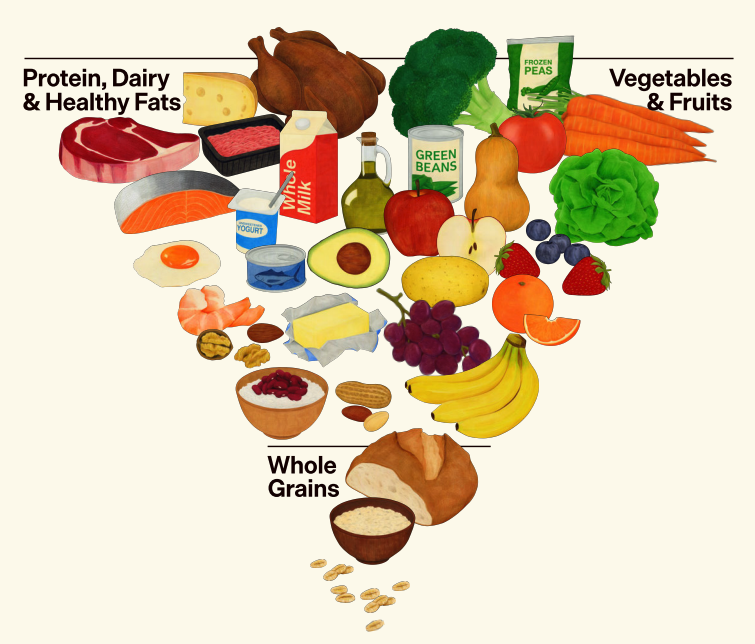
The most prominent theme in the 2025-2030 US dietary guidelines is a call to return to whole, nutrient-dense foods. The introduction emphasizes prioritizing protein, dairy, vegetables, fruits, healthy fats, and whole grains while dramatically reducing highly processed foods high in refined carbohydrates, added sugars, sodium, unhealthy fats, and chemical additives.
This is framed as a response to rising chronic disease rates. The report highlights high levels of obesity, prediabetes in adolescents, and diet-related chronic illness as major public health concerns.
The tone is direct and urgent. These dietary guidelines position food quality, not just calorie balance, at the center of national health strategy. Below is the updated food pyramid:

Take a Peek Inside AFPA’s Holistic Nutrition Coach Certification
Curious what it’s really like to study holistic nutrition at a professional level? Get the free course preview and see the actual learning modules, frameworks, and real-world coaching applications that prepare AFPA graduates for success.
Protein Takes Center Stage
One of the more notable shifts in the new US dietary guidelines is the emphasis on prioritizing high-quality, nutrient-dense protein foods at every meal.
The guidelines recommend:
- Consuming a variety of protein sources from both animal and plant foods
- Including eggs, poultry, seafood, red meat, beans, lentils, nuts, seeds, and soy
- Aiming for 1.2 to 1.6 grams of protein per kilogram of body weight per day
This protein range is higher than previous baseline recommendations for some populations and reflects growing attention to muscle mass, metabolic health, and aging.
The guidelines also suggest preparing protein foods using cooking methods such as baking, broiling, roasting, grilling, or stir-frying rather than deep frying.
For health professionals, this reinforces the importance of adequate protein intake across the lifespan, especially for older adults and physically active individuals.
Full-Fat Dairy Reintroduced
Another update within the American dietary guidelines is the inclusion of full-fat dairy products with no added sugars as part of a healthy dietary pattern.
The guidelines recommend approximately three servings of dairy per day in a 2,000-calorie pattern, adjusted for individual needs.
This reflects a continued evolution in the conversation around dietary fats. While saturated fat intake should not exceed 10 percent of total daily calories, the guidelines acknowledge that whole foods containing fats can be part of a nutrient-dense diet.
For practitioners, this highlights the importance of food context rather than isolating nutrients without considering the full dietary pattern.
Vegetables, Fruits, and Whole Grains Still Matter
The 2025-2030 USDA dietary guidelines chart emphasizes vegetables, fruits, and whole grains as core pillars.
For a 2,000-calorie dietary pattern, recommended daily targets include:
- 3 servings of vegetables
- 2 servings of fruits
- 2 to 4 servings of whole grains
The guidelines encourage eating vegetables and fruits in their whole form as well as whole grains. They encourage limiting refined carbohydrates, such as white bread and packaged breakfast foods, and juice intake.
This aligns with long-standing dietary guidelines for healthy eating, reinforcing fiber intake, phytonutrients, and glycemic stability.
A Stronger Stance on Highly Processed Foods
Perhaps the most explicit language in the new dietary guidelines addresses highly processed foods.
The report advises avoiding highly processed packaged and ready-to-eat foods that are high in added sugars and sodium. It also recommends limiting foods and beverages that include artificial flavors, petroleum-based dyes, artificial preservatives, and non-nutritive sweeteners.
The guidelines specify:
- No amount of added sugars is recommended as part of a healthy diet
- One meal should contain no more than 10 grams of added sugars
- Sugar-sweetened beverages such as sodas and energy drinks should be avoided
This goes beyond previous sugar percentage limits and places more direct constraints at the meal level.
Sodium and Alcohol Recommendations
The US dietary guidelines sodium recommendation remains under 2,300 milligrams per day for the general population aged 14 and older. Lower thresholds apply for children based on age.
Highly processed foods high in sodium should be avoided.
Regarding US dietary guidelines for alcohol consumption, the message is simple: consume less alcohol for better overall health. Certain groups should completely avoid alcohol, including pregnant women and individuals recovering from alcohol use disorder.
This reinforces the broader public health shift toward reducing alcohol intake.
Guidance Across the Lifespan
The dietary guidelines for Americans continue to provide stage-specific recommendations.
Infancy and Early Childhood
For about the first six months, infants should be exclusively breastfed when possible, or receive iron-fortified formula. Vitamin D supplementation of 400 IU per day is recommended for breastfed infants.
Added sugars should be avoided in infancy and early childhood.
Early introduction of potentially allergenic foods such as peanuts, eggs, and shellfish is encouraged around six months, with medical guidance as needed.
Middle Childhood and Adolescence
Children and adolescents are encouraged to focus on nutrient-dense foods, avoid added sugars, and limit highly processed options.
Adolescents have increased needs for energy, protein, calcium, and iron, particularly girls due to menstruation.
Pregnancy and Lactation
Pregnant women are advised to prioritize iron, folate, iodine, and choline-rich foods, including eggs, leafy greens, legumes, dairy, and low-mercury seafood.
Lactating women require increased energy and nutrient intake to support milk production.
Older Adults
Older adults may require fewer calories but equal or greater amounts of protein, vitamin B12, vitamin D, and calcium.
This supports the growing emphasis on nutrient density rather than calorie density in older adults.
Considerations for Chronic Disease and Plant-Based Diets
For individuals with chronic disease, the guidelines suggest that following the dietary guidelines can help reduce the onset or progression of cardiovascular disease, obesity, and type 2 diabetes. In some cases, lower carbohydrate approaches may be appropriate under medical supervision.
Vegetarian and vegan diets are acknowledged, with guidance to prioritize whole plant foods and monitor for potential nutrient gaps, including vitamin B12, vitamin D, iron, calcium, and iodine.
This is especially relevant for practitioners working with clients following plant-based patterns.
What This Means for Health Professionals
These government guidelines offer a broad public health framework, but effective nutrition practice requires nuance, behavior change support, and a deeper understanding of individuality.
Several themes stand out in the 2025-2030 edition:
- Food quality matters
- Protein adequacy is emphasized more strongly
- Highly processed foods are clearly discouraged
- Added sugars are increasingly restricted
- Lifespan nutrition remains central
For coaches and nutrition professionals, this means:
- Helping clients build sustainable eating patterns rooted in whole foods
- Educating on label literacy and identifying added sugars
- Supporting appropriate protein intake based on body size and activity
- Addressing barriers to food access and preparation skills
The dietary guidelines for Americans provide direction. The role of the practitioner is to translate that direction into practical, culturally relevant, and individualized strategies.
Taking the 2025-2030 Dietary Guidelines Into Account
The new dietary guidelines reflect a strong push toward real food, nutrient density, and reduced reliance on highly processed products. They underscore the reality that diet-related chronic disease remains one of the most significant public health challenges in the United States.
For individuals, the takeaway is simple: prioritize whole, minimally processed foods, ensure adequate protein and micronutrient intake, and limit added sugars and sodium.
For professionals, the opportunity is even greater. Education, coaching, and personalized support are what transform guidelines into meaningful, lasting change.
If you would like to review the full report, see the official Dietary Guidelines for Americans, 2025-2030.
The future of public health will be shaped not only by policy, but by how effectively we translate recommendations into action.
Take a Peek Inside AFPA’s Holistic Nutrition Coach Certification
Curious what it’s really like to study holistic nutrition at a professional level? Get the free course preview and see the actual learning modules, frameworks, and real-world coaching applications that prepare AFPA graduates for success.

Reviewed by
Kellie Lunday, MS, RD, LD, NBC-HWC
Kellie Lunday is AFPA’s nutrition content lead and a registered dietitian with nearly a decade of experience in corporate wellness, health education, and performance optimization. She received her MS in Nutrition from Texas Woman’s University and completed her dietetic internship at The University of Texas in Austin. Previously, she has worked in various roles at Exos and the University of Texas at Austin. She is passionate about travel, global cuisines, fitness, and advancing consumer health through evidence-based education.
