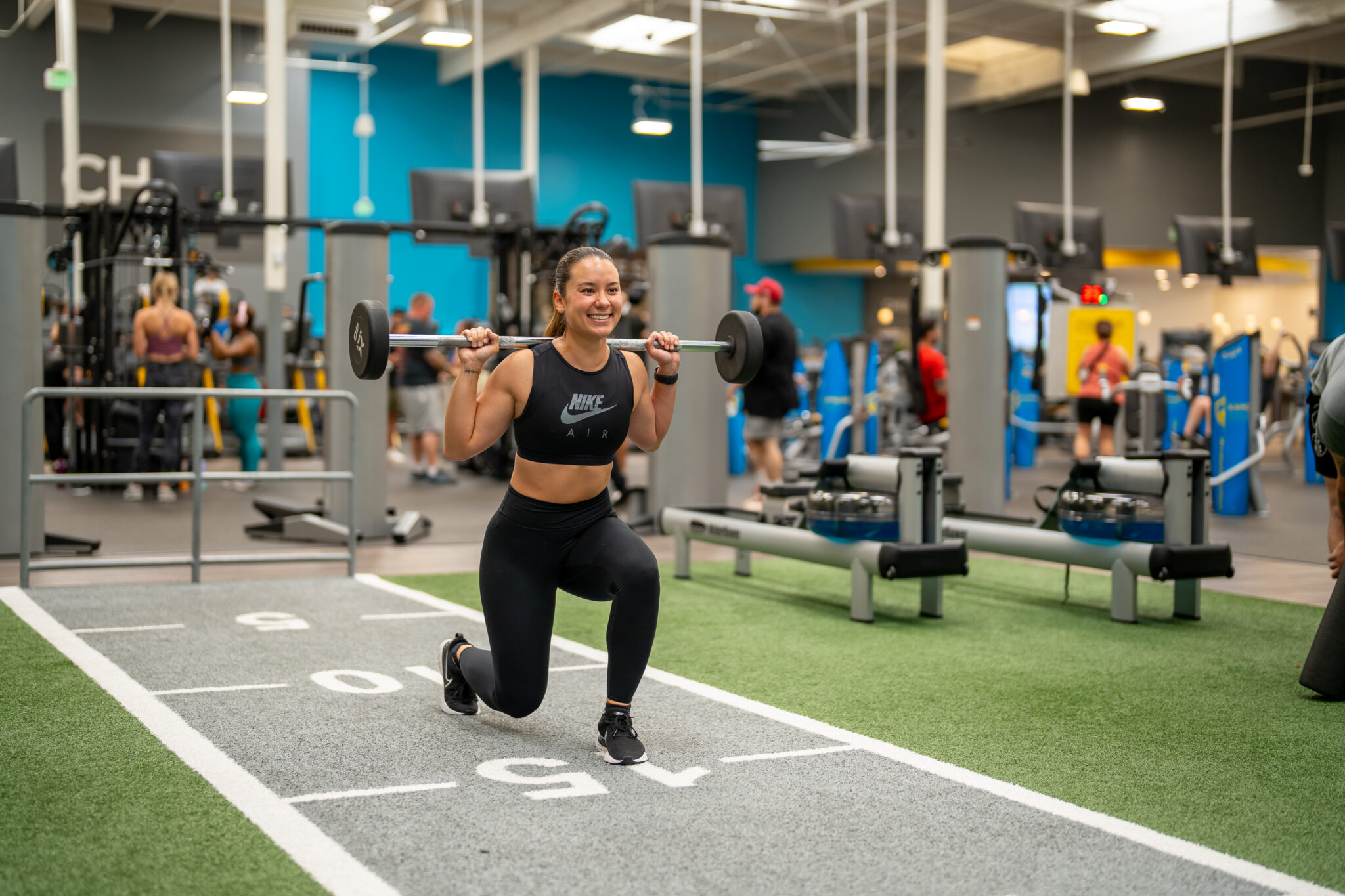
Strength training benefits adults of all ages, and anyone can start, no matter their background, experience, or current fitness level. Building muscle through resistance exercises can support overall strength, bone density, and mobility.
It can also help you maintain a healthy body weight. Getting strong can even help boost your self-confidence and support better attention, focus, and memory abilities.
With the right approach, plan, and commitment to consistency, anyone can succeed at strength training. If you’re new to lifting or returning after some time off, this guide will walk you through how to start strength training with practical tips and pointers for beginners.
Benefits of Strength Training
Why start strength training? To reap the many benefits, including:,
- Increased muscle strength
- Improved bone density
- Better joint support
- Injury prevention
- Enhanced metabolism
- Easier weight management
Outside the gym, a stronger body can help you carry out everyday tasks and perform basic movements, like walking upstairs, opening a jar, lifting a box, or chasing after your kids. Not only that, but more muscle mass helps your body burn more calories throughout the day, even at rest, which can help you maintain a healthy body weight.
Resistance training might even help protect against chronic disease and back pain while supporting mental sharpness. As mentioned, it can give you a self-esteem boost, not only with regard to how you look but also with what your body can do.
What Is the Best Way to Start Strength Training?
The best way to start strength training is with a progressive plan that starts slowly and levels up at a comfortable pace. Consistency is key, but just as important as keeping up with a workout routine is avoiding overtraining.
To get started safely and set yourself up for success, it’s crucial to choose the right weights and machines, learn the basic movements, understand reps and sets, be familiar with the major muscle groups, and progress slowly.
1. Choosing the Right Weights and Machines
Beginners should generally start with light weights. Hand weights (dumbbells) are often recommended for those starting out with strength training. Everyone is different, but you might begin with a pair of 3-, 5-, or 8-pound weights for your first several sessions.
You may need to try a few weights to figure out what to start with. Generally speaking, you should be able to lift the dumbbells 12 to 15 times comfortably. Don’t worry—you can absolutely increase your strength with lighter weights and work your way up to heavier dumbbells.
Resistance machines can also be beginner-friendly, with a low risk of injury. Just make sure to ask a staff member or trainer at the gym if you’re unsure how to use them.
2. Learning Basic Movements
Proper form is essential when strength training. It supports more efficient gains in strength and long-term progress while helping you avoid injury or strain.
This includes proper form with free-weight exercises, such as overhead presses, chest presses, bicep curls, and dumbbell rows, as well as with resistance machines. You’ll also want to be up to speed with bodyweight exercises, like squats, lunges, planks, and push-ups.
You can follow along with strength training videos at home, reference a beginner’s guide on a mobile app, get professional pointers from a personal trainer, or join a small-group class for beginners. In any case, learning the basic movements is a critical first step in your training program. If you can’t maintain proper form through each rep of a movement, you might need to lower your weight or do fewer reps.
3. Understanding Reps and Sets
You might hear the words “reps” and “sets” thrown around a lot by trainers and gym-goers. Knowing these terms is important when creating and following a strength training plan, but they’re pretty straightforward.
Short for repetitions, reps are the number of times you perform an exercise. Sets are how many times you repeat a group of reps. For instance, if you do 20 squats in a row, that’s one set of 20 reps. If you repeat this three times with a short rest in between, you’d be doing three sets of 20 reps.
When strength training, you usually do a higher number of reps when using lighter weights and fewer reps with heavier weights.
4. Knowing the Major Muscle Groups
To gain strength, maintain good physical health, and reap the benefits of resistance training, you’ll generally want to work all the major muscle groups at least twice a week.
This includes your:
- Upper body – Upper-body strength training targets the arms, shoulders, and chest.
- Core – Core exercises focus on the front (abdominals) and back of your trunk, including your lower and upper back.
- Lower body – Lower-body training involves the glutes, hips, and legs.
5. Progressing Slowly
Your best bet with strength training is to take it slow, progress at a comfortable pace, and avoid overtraining.
Doing intense sessions with heavy weights before you’re ready, doing too many reps, or not getting enough rest in between can lead to injury or burnout. The idea is to build a new habit, set a plan for continuous progress, and be consistent over the long term.
Common Beginner Concerns When Strength Training
When you’re just starting out with strength training, it’s normal and understandable to be worried about proper form, concerned about getting hurt, or overwhelmed by the unfamiliarity of a gym setting.
That’s why it’s so crucial to learn the fundamentals first (reps, sets, muscle groups, basic movements, etc.), create a game plan, start slowly, and progress at an appropriate pace.
Beyond that, don’t be afraid to ask for help when you need it. A personal trainer or weight room attendant can answer any questions you might have about how to use resistance machines, proper form, what weight to start with, and how many reps or sets to do.
Progress Comes From Consistency and Patience
Remember, progress in the gym comes from consistency and patience. You can’t expect to see results overnight. It’s worth taking your time to learn proper technique and make gradual increases in weight, reps, and intensity rather than lifting heavy right away or diving in without a plan.
How Often Should Beginners Strength Train?
If you’re new to resistance training and want to see improvements in your overall fitness, you’ll want to do at least one session a week that hits all major muscle groups for the first few months.
For ongoing progress and general good health, other guidelines recommend strength training two times a week at a minimum.,
3-3-3 Rule for Strength Training
The 3-3-3 rule suggests doing three days of strength training, three days of aerobic exercise (cardio), and three days of rest or active recovery each week. This would mean that on some days, you’ll do both resistance training and cardio.
Active-recovery days could involve not doing a structured workout and instead going on an easy walk or doing a few mobility exercises, like arm swings, hip rotations, or leg circles.
3-2-1 Rule for the Gym
The 3-2-1 rule for the gym involves doing three strength training sessions a week, two workouts that focus on core, mobility, or flexibility (like yoga or Pilates), and one day of dedicated cardio.
This format is a little more beginner-friendly than the 3-3-3 rule. It might also be more sustainable and easier to stick with long-term, as it’s flexible and helps you avoid burnout.
Guided Strength Training for Beginners
Guided strength training environments can be immensely helpful for beginners. They support those just starting out with resistance exercises through coaching, teaching proper form, and small-group instruction, all in an encouraging, welcoming setting.
Dedicated Strength Spaces
Dedicated strength spaces like the Chuze Lift Lab allow people of all fitness levels to access high-quality training equipment in a designated, private area. This allows you to focus on your sets and use all the tools you need to make progress, without the crowd or outside distractions.
Members can access benches, squat racks, lifting platforms, dumbbells, kettlebells, and other specialized equipment. You can also join Lift Club and do small-group lifting sessions led by certified personal trainers to learn new techniques and stay motivated with your strength training plan.
Beginner-Friendly Support From Chuze Fitness
Chuze Fitness is a place where you can start your fitness journey, improve your strength over time, and become more comfortable and confident in the gym. We welcome people of all life stages and fitness levels, offering support through flexible gym memberships, clean facilities, professional guidance, and top-of-the-line equipment.
At Chuze, you can access structured strength spaces, guided group lifting sessions, and other helpful resources for beginners. At select locations, new members can do a complimentary hour-long FitStart Session with a certified fitness instructor. Sign up today or try a gym trial to explore what Chuze has to offer.
Sources:
Current Sports Medicine Reports. Resistance training is medicine: effects of strength training on health. https://pubmed.ncbi.nlm.nih.gov/22777332/
Exercise, Sport & Movement. The Health Benefits of Resistance Exercise: Beyond Hypertrophy and Big Weights. https://journals.lww.com/acsm-esm/fulltext/2023/01000/the_health_benefits_of_resistance_exercise__beyond.2.aspx
Sports Medicine. Minimalist Training: Is Lower Dosage or Intensity Resistance Training Effective to Improve Physical Fitness? A Narrative Review. https://pmc.ncbi.nlm.nih.gov/articles/PMC10933173/
Sports Medicine. No Time to Lift? Designing Time-Efficient Training Programs for Strength and Hypertrophy: A Narrative Review. https://pmc.ncbi.nlm.nih.gov/articles/PMC8449772/
Medicina Sportiva. Evidence-Based Resistance Training Recommendations. https://www.researchgate.net/publication/228830087_Evidence-Based_Resistance_Training_Recommendations
American Heart Association. Strength and Resistance Training Exercise. https://www.heart.org/en/healthy-living/fitness/fitness-basics/strength-and-resistance-training-exercise
BMC Sports Science, Medicine and Rehabilitation. Effect of free-weight vs. machine-based strength training on maximal strength, hypertrophy and jump performance – a systematic review and meta-analysis. https://pmc.ncbi.nlm.nih.gov/articles/PMC10426227/
Sports (Basel). Knowledge of Targeted Muscles and Proper Form in Strength Training: A Cross-Sectional Survey of 1000 Adults Across Age, Sex, and Instructional Experience. https://pmc.ncbi.nlm.nih.gov/articles/PMC12473838/
Mayo Clinic. Weight training: Do’s and don’ts of proper technique. https://www.mayoclinic.org/healthy-lifestyle/fitness/in-depth/weight-training/art-20045842
U.S. Department of Health and Human Services. Physical Activity Guidelines for Americans, 2nd Edition. https://odphp.health.gov/sites/default/files/2019-09/Physical_Activity_Guidelines_2nd_edition.pdf
Mayo Clinic. Strength training. https://www.mayoclinic.org/healthy-lifestyle/fitness/basics/strength-training/hlv-20049447
