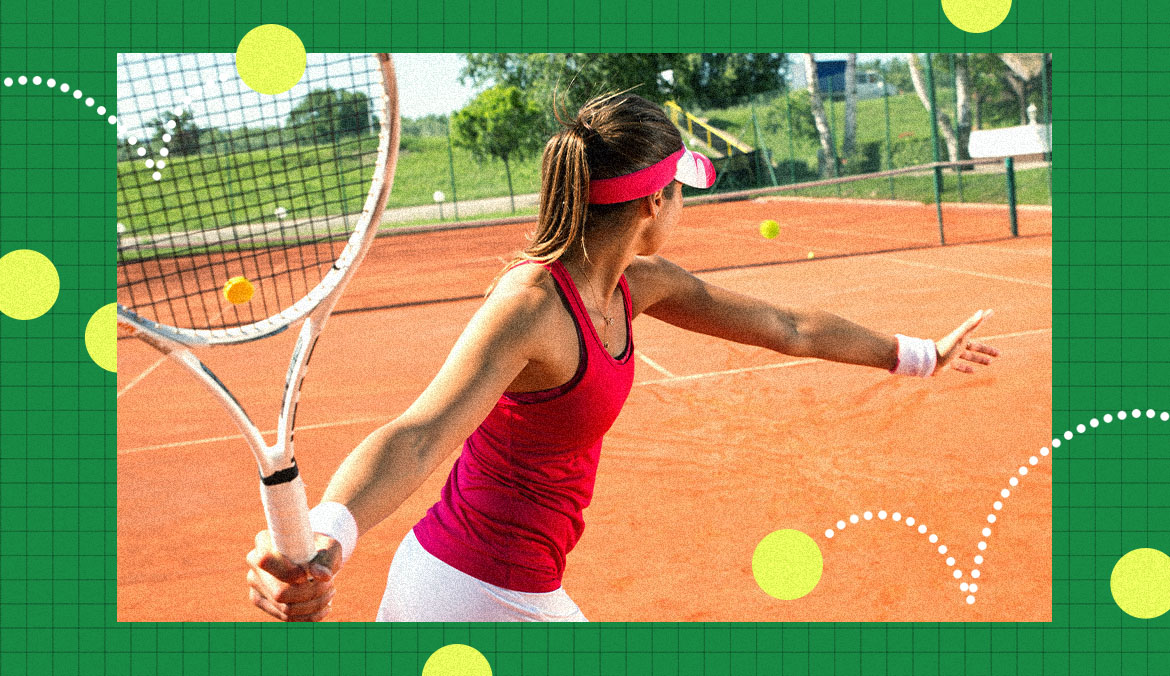
Historically, my exposure to tennis has been minimal. My family never belonged to a country club. I didn’t play on the high school team. There was that annual unit in P.E. when we’d excavate a handful of dusty, warped rackets from the gym’s supply closet (this was public school in the ’90s, so they were definitely wooden and missing strings) and spend the next 45 minutes whiffing serves and chasing balls across the multi-purpose courts.
I got the sense that playing tennis could be fun if you knew what you were doing. The kids who brought in their own rackets from home and managed to sustain a rally appeared to be having a good time. But, unlike more familiar pick-up team sports like basketball or softball, tennis felt inaccessible. I didn’t have a clear entry point.
Decades later, I found one. Pickleball and racket sports were having a moment, which felt like an open invitation to finally give tennis a shot. I was bored with my regular fitness routine, a healthy but predictable mix of running, strength training, yoga, and Pilates. So, I ordered a tennis racket online and registered for adult beginner lessons at Court 16, a New York City-based tennis and pickleball club.
Trading the comfort zone for the court
My first lesson went great. I stepped onto the court with confidence, followed the coach’s instructions, and by the end of the hour-long session, I was ready to bump up to the intermediate clinic.
Related Stories
Just kidding. Tennis is one of the most difficult sports to learn, and I quickly realized that I’m not some latent phenom. Even though I was excited to try something new, trading the familiarity of my gym and living room workouts for an entirely unknown experience stirred up feelings of anxiety, self-consciousness, and self-doubt.
Seiji Takaku, PhD, professor of sports psychology at Soka University in Aliso Viejo, California, explains that stepping outside your comfort zone can become even more challenging as you age.
“When you’re young, you try new things, and it’s very exciting,” he says. There’s novelty in every experience, stakes and expectations are low, and you’re accustomed to making mistakes. “As we get older, we become creatures of comfort. I think that has a lot to do with the physical and cognitive decline that naturally comes with age.”
Essentially, sticking to what you know is a protective mechanism that prevents us from getting injured—physically and psychologically. For the most part, it’s useful. Personally, living my adult life with the same sense of adventure I had as a teenager sounds dangerous and potentially humiliating.
But if you never push back against the boundaries of your comfort zone, you stop growing as a person. “If we want to improve ourselves, we must be comfortable with being uncomfortable,” Dr. Takaku says.
Persistent beginners vs. frustrated quitters
I tried to remember Dr. Takaku’s words every time I felt embarrassed or uncoordinated on the court, which happened at least a couple of times during every session. In fact, my third tennis lesson was surprisingly more frustrating than my first, back when I was mentally prepared to suck. Shouldn’t I be progressing faster than this? I wondered.
Anthony Evrard, CEO and co-founder of Court 16, is quick to point out that tennis is a highly technical sport that requires practice. Patience is one of the factors that separates successful beginners from those who get discouraged and quit.
“You’re not going to go on a court and start to rally after two hours of classes. It takes time and perseverance,” he says.
According to Ulrick Vieux, DO, a psychiatrist at Hackensack Meridian Health in Edison, New Jersey, one way to foster patience is to think about your goal as a series of smaller, progressive goals.
“One of the things that prevents people from [stepping outside their comfort zone] is the fear of not being able to complete [their goal]. If you focus on the small steps—the small wins—when you look back a year later, you’ll be amazed by what you’ve accomplished.”
My initial “big goal” of playing a match was actually too aggressive for a beginner. I was skipping a lot of important steps, like developing foundational skills and an understanding of the game. Identifying and working toward process-oriented goals instead of outcome-oriented goals helped me generate momentum while keeping my expectations in check.
For example, rather than focusing on my performance, I set an intention to meet up with friends at the public courts once a week. During lessons, I’d pick one piece of feedback—like swinging “low to high” or turning my shoulders in time—and hyperfocus on that for the hour. So, regardless of the outcome, I felt like I accomplished something.
“When you’re young, you try new things, and it’s very exciting. As we get older, we become creatures of comfort.” —Seiji Takaku, PhD
That sense of accomplishment from learning a new sport or skill can transcend the court or field and carry over into other aspects of our lives. “Every successful experience feeds into our self-confidence, and that’s what we need to be successful in any arena of our life—business, parenting, relationships,” Dr. Takaku says.
The simple act of trying something new, regardless of the outcome, can also broaden your thinking. “It’s very easy to only see things from our perspective and not necessarily empathize with others,” Dr. Vieux says. “Getting out of your comfort zone allows you to see things from other perspectives.”
I can’t say that my worldview has been changed by tennis, but I have met new people, visited unfamiliar neighborhoods, and connected with friends in different ways since starting to play. And I think I understand my 5-year-old’s inability to lose any game with grace just a little bit better.
Tips for learning tennis (or any new sport) as an adult
Big-picture thinking and life lessons aside, it’s fine to pick up a new sport just because it seems fun, you’re curious about it, or you want to get some exercise. That’s how all of this started and why I keep coming back—tennis is an excellent workout, and I’m having a good time! I’m also starting to see some progress, thanks to patience, consistency, and these expert-backed tips.
1. Keep a journal
Evrard recommends that every player, regardless of experience level, take a few minutes after a class, practice, or game to jot down some thoughts. “Reflect on what has worked that day. When did you feel like you were making good contact with the ball? Write it down,” he says, so that you can carry your learnings forward into your next time on the court. Not sure where to start? “Ask your coach for feedback. Try to learn three things after every lesson,” he suggests.
2. Scale accordingly
Beginner-specific gear, drills, and games can make the learning experience more enjoyable and fruitful. Evrard recommends starting with low-compression tennis balls, which are slightly bigger and travel more slowly. He also suggests hitting from the middle of the court, not the baseline, as you’ll spend less time chasing down missed balls and more time connecting with them. “Hit slowly and try to build that consistency.”
3. Record your progress
We poke fun at fitness influencers who record every workout, but there’s value in capturing video of yourself in action, especially during those first few times on the court. “We have this narrow vision of comparing ourselves right now to ourselves of yesterday. We cannot see the growth,” Dr. Takaku says. “But if you see yourself in a much longer period, even three weeks or a month, you will see amazing progress.”
4. Invest in instruction
If your budget allows, work with a coach who has experience teaching beginners. “There are amazing coaches who coach college athletes or professional players, and you put them in front of a beginner, and they don’t know how to start a class or how to connect because they can’t think like a new player,” Evrard says. Also, every coach has their own style, personality, and approach. It may take a few tries to find someone with whom you connect.
