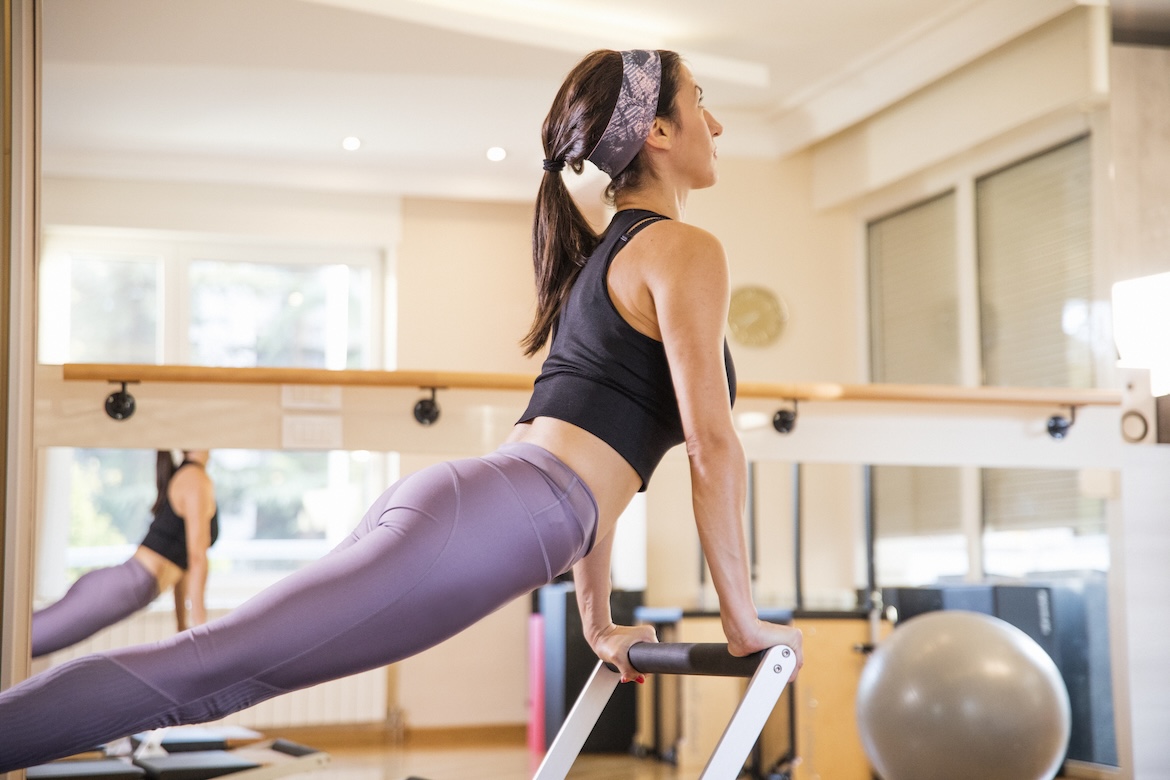
However, you may start to wonder if you can overdo it, especially if Pilates is now an integral part of your morning or evening routine. Here’s what experts say about how often to practice Pilates, the best way to adjust your workouts to avoid overuse—plus, which activities to pair with it.
That said, keep in mind that the best progression and activity levels ultimately depend on you as an individual—so when in doubt, chat with your doctor or a personal trainer based on your own history and abilities.
Related Stories
How often should you do Pilates?
Good news for Pilates lovers: You can technically do this practice every single day if you’re otherwise cleared by your doctor. However, some modifications are needed to make sure you don’t put yourself at risk for injury.
“There is certainly no harm in practicing a bit everyday, but I recommend a 45- to 60-minute medium to intense Pilates workout on equipment or mat work every other day—and a short pre-Pilates or flexibility targeted session in between,” says Portia Page, CPT, NCPT, a Pilates instructor and fitness educator with Balanced Body.
In other words, if you practice Pilates daily, make sure you’re incorporating lighter workouts in between your heavier ones. To avoid getting bored, you may also want to incorporate other types of light exercises into your workout routine (more on that shortly).
The type of Pilates you practice also makes a difference. There are two main types of Pilates: reformer Pilates (which uses the Pilates reformer machine, typically in a studio) and mat Pilates (done on a thick mat in the studio or at home, often with props like a foam roller or hand weights).
You may also try Cadillac Pilates (which involves a machine similar to the reformer, but with a four-post frame that has various bars and straps) or chair Pilates (which involves a chair-like machine and elements that resemble both reformer and mat Pilates).
“When you use only the reformer as your apparatus for Pilates exercise, you can become dependent on the support of the springs, which can stall progress or make some muscle groups weaker,” says Theresa Barone, CPT, senior Pilates leader at Life Time.
As you consider Pilates instructors or studios, look for those that teach not only reformer Pilates, but also other varieties such as Cadillac, chair, and mat Pilates. These different practices will complement each other to provide you with the most comprehensive workout.
“The mat makes you stronger to advance on an apparatus like the reformer, Cadillac, and chair—and those, in turn, make you stronger on the mat. Both are essential pieces to the puzzle,” Barone says.
How do you know if you can level up your Pilates practice?
If you’re new to Pilates, Barone recommends starting with one session per week, and gradually, over the span of about four to eight weeks, increasing your frequency to two to three times per week. At that time, you may find you feel stronger, more energetic, and have fewer aches and pains, helping you to level up your practice.
But don’t rush it: Practicing Pilates too often or too long when you’re not ready can lead to risk of injury, just like any other exercise.
“Not giving the body sufficient rest and restoration will make the muscle fatigue and soreness more acute and could eventually lead to overuse or injury to high-use joints, especially if the workout isn’t varied,” Page says.
Repeating the same movements in excess damages tissues and is what leads to overuse injuries. This can be avoided by allowing time for rest and following proper techniques, per the Hospital for Special Surgery (HSS).
Also make sure your practice is varied, especially if you’re practicing Pilates on a near-daily or daily basis.
“Keep your workout well-rounded and focused on the whole body,” Page says. “Don’t just focus on one plane of motion or the same movements every day.”
Try to target all of your muscle groups from top to bottom during every workout session, but vary the intensity and the types of movements.
“You can even use mixed modality movement, like yoga with Pilates, to build in rhythm and flow,” Page says. “Meanwhile, use the Pilates equipment to target specific areas of strength or flexibility that are necessary for whole-body movement and balanced muscle development and control.”
If you do get an overuse injury, you will likely need to rest the area to allow it to heal—which can take weeks to months, per the HSS.
“My personal goal is to mix it up a bit every day with workouts that incorporate full-out Pilates sessions—either on the mat or the equipment—and other modalities such as weight training, yoga, tai chi, walking, playing a sport, and so forth.” —Portia Page, CPT, NCPT
Which workouts are best for Pilates “off” days?
When you don’t practice Pilates, you can still stay active with other activities that complement it but don’t target the same exact muscles or joints.
“My personal goal is to mix it up a bit every day with workouts that incorporate full-out Pilates sessions—either on the mat or the equipment—and other modalities such as weight training, yoga, tai chi, walking, playing a sport, and so forth,” Page says.
Weight training is great for building muscle and bone density, plus overall confidence and strength. Meanwhile, sports like tennis or volleyball can be ways to add more fun to your routine.
“Even walking the dog works,” Page says. “Go a bit further than normal or take a different route to mix it up and add variety.”
You may also find that water sports help soothe your muscles and joints in between Pilates sessions, along with other key perks. Swimming helps your joints and ligaments stay flexible and loose, expands your lung volume, and makes your heart stronger, per Michigan State University.
“If you’re looking for low impact on the joints or body, it feels great to combine Pilates with a few days in the pool, whether it’s swimming or aqua aerobics,” Barone says.
Finally, mind-body exercises that help build your focus can benefit your Pilates practice, plus other areas of your life.
A 2021 study in the International Journal of Environmental Research and Public Health found that practicing Pilates and yoga for eight weeks made participants more likely to adopt healthy lifestyle changes—such as eating healthy, staying active, maintaining healthy social relationships, managing stress, and emphasizing spiritual growth—than those who did not.
“Yoga is great for adding another mindful modality that focuses on breathing and stretching,” Page says.
The bottom line
If you’re interested in incorporating Pilates into your everyday routine, remember to start slow, listen to your body, and rest when needed. This may mean beginning with one Pilates session per week and gradually increasing to two or three sessions per week over the span of one to two months.
Eventually, if your fitness level allows, you can do Pilates daily—but incorporate heavier workout days with lighter ones that focus more on stretching. You can also swap out Pilates some days for complementary activities like walking, swimming, or yoga.
Keep your workouts varied to prevent overuse injuries. When in doubt, talk with a certified personal trainer or your doctor about the best way to get started and progress based on your own activity levels or underlying conditions.
Well+Good articles reference scientific, reliable, recent, robust studies to back up the information we share. You can trust us along your wellness journey.
-
Lim EJ, Hyun EJ. The Impacts of Pilates and Yoga on Health-Promoting Behaviors and Subjective Health Status. Int J Environ Res Public Health. 2021 Apr 6;18(7):3802. doi: 10.3390/ijerph18073802. PMID: 33917304; PMCID: PMC8038747.
