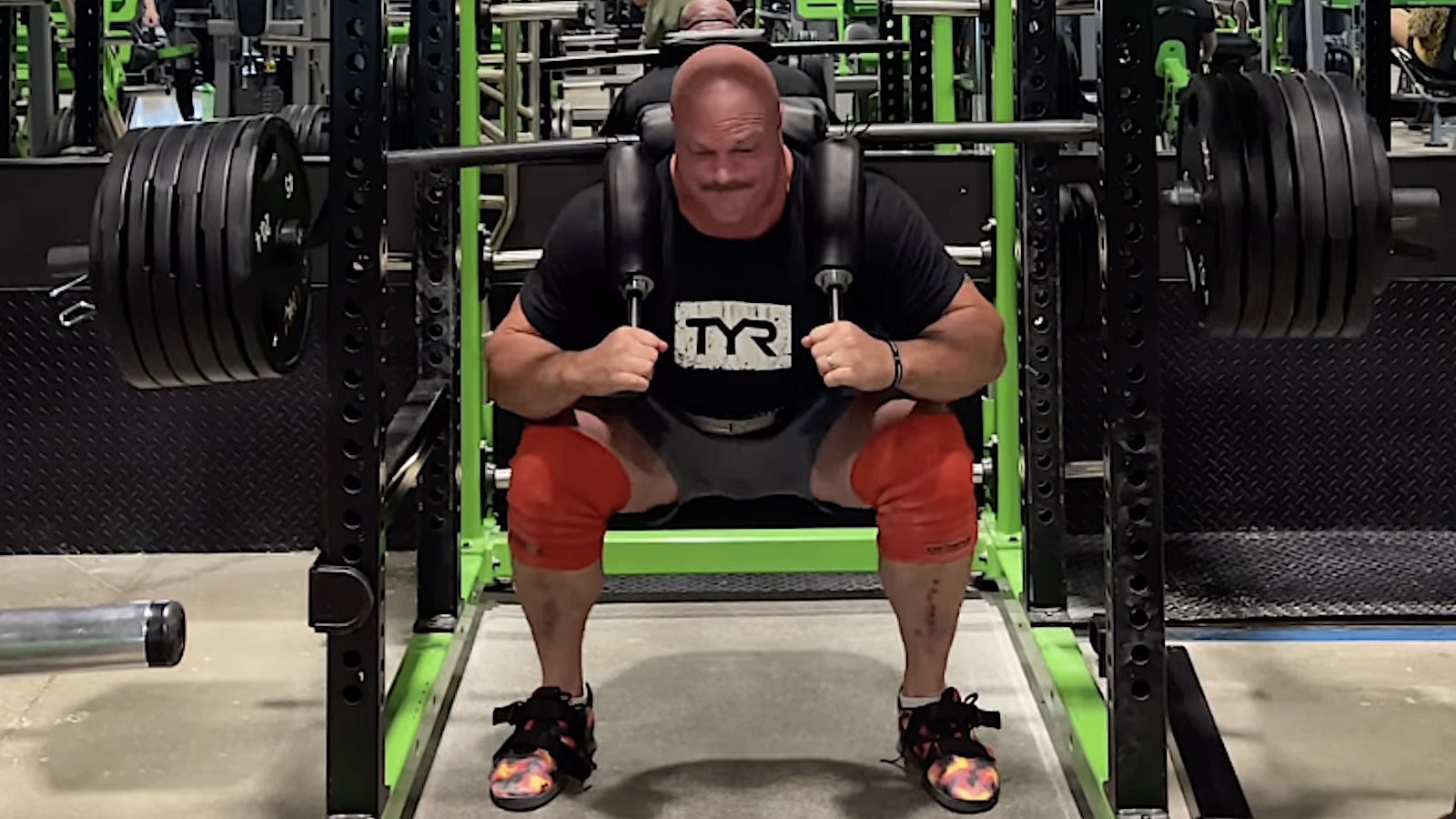
2024 Strongest Man on Earth Mitchell Hooper suggests a rep range of one to five for maximum strength gains.
Last updated on September 16th, 2024

In 2024, strongman Mitchell Hooper won the 2024 Strongest Man on Earth (SMOE), the 2024 Arnold Strongman Classic (ASC), the 2024 ASC UK, the 2024 Strongman Classic, the 2024 Giants Live World Tour Open, and ranked as runner-up to Tom Stoltman at the 2024 World’s Strongest Man (WSM). That consistency is thanks, in part, to insights he offered into his training for strength gains.
On Sept. 5, 2024, Hooper addressed why one should avoid high reps when aiming to increase strength. He outlined six key points:
6 Reasons to Avoid High-Reps
- Energy Expenditure
- Skill Building
- Muscle Fiber Type
- Injury Risk
- Varied Recruitment Patterns
- Exercise Selection Doesn’t Match Strength Gains
[Related: You Want Muscle Growth: Will Higher Training Volumes Help or Hurt?]
[Related: Scientists Astonished by Eddie Hall’s Extra-Large “Guy Ropes”]
Energy Expenditure
When performing more than five reps, consider the time it takes to complete each set. Hooper notes that phosphocreatine powers initial movements, transitioning to the glycolytic system after five seconds, where glycogen sustains that activity. Therefore, activating the correct energy system to get peak strength is critical.
A hard set of six squats or deadlifts could very well take 30-plus seconds.
Hooper explains why the world’s strongest athletes typically weigh over 300 pounds. “Weight does move weight,” said Hooper. “If you lift with higher rep ranges, you will not have the same effect nor put on the same amount of mass as you would in lower rep ranges.”
Although strongmen should prioritize strength, that doesn’t diminish the significance of overall fitness, as recovery between sets is vital. Taking total work capacity into account, Hooper said, “We know building strength doesn’t require a huge amount of volume; it requires a huge amount of load.”
Skill Building
Lifting heavy is a learned skill that involves recruiting specific muscles necessary for a given movement.
You must find the correct group of muscles in a compound movement to perform that movement effectively, safely, and with as much muscle mass as possible.
Failing to grasp how to recruit the proper motor units and muscles can lead to significant risks, including:
- Poor performance
- High risk of injuries
- Low chance of hitting personal bests
- Plateaus
- Loss of technical control
[Related: How I Trained My Motor Cortex to Help Me Squat More]
Muscle Fiber Type
Understanding muscle fiber types’ role in strength training is valuable knowledge in the gym.
- Type I Muscle Fibers: Slow-twitch
- Type II Muscle Fibers: Fast-twitch ranging from type IIA to type IIX.
- Type IIA is the most fatigue-resistant and least powerful to type IIX, which is the most powerful and least fatigue-resistant.
When lifting heavy weights, the objective is to engage as many Type II muscle fibers as possible to maximize explosiveness and strength (1). This contrasts with the outcomes of performing higher reps.
You can’t switch Type I to Type II and make your whole body fast-twitch and powerful.
[Related: Bulking vs Cutting: Are Higher or Lower Reps Better?]
Injury Risk
Hooper explained that fatigued muscles are prone to spasms, leading to tears and muscle damage when combined with training load. Tendons and ligaments are soft tissues lacking a direct blood supply, making it challenging to adapt them like muscles. Be cautious when increasing volume significantly.
Varied Recruitment Patterns
With each rep, the body subtly alters its technique to adapt when learning to become stronger. However, this isn’t the primary advantage of lifting heavy weights. According to Hooper, two key outcomes occur when engaging in heavy lifting:
- Extend the shortened cycle significantly by quickly lowering the weight, explosively lifting it, and powering through the reps. This emphasizes power rather than strength.
- Slowly move the weight and exert maximum effort on the target muscles to promote muscle hypertrophy, even as one experiences decreased power and strength.
The Exercise Selection Doesn’t Match Strength Gains
Hooper argues that compound movements are not ideal for high rep ranges, citing deadlifts as a specific example. This can lead to injuries and discourage individuals from increasing their workout volume and building strength.
A set of 15 deadlifts will blow up your back and glutes. You won’t get…what a good deadlift should feel like.
Machines don’t truly measure strength gains. “Any strength test that holds water will use free weights,” Hooper explained. “Generally speaking, deadlifts, bench press, and squats are how people measure strength.
Hooper recommends a rep range of one to five reps to gain strength for compound movements. However, novice lifters can perform more reps to enhance their fitness and build muscle. Hooper advised against low-rep training on accessory and rowing movements, such as a lat pulldown or a bent-over row, which can spur lousy form.
Reference
- Plotkin, D. L., Roberts, M. D., Haun, C. T., & Schoenfeld, B. J. (2021). Muscle Fiber Type Transitions with Exercise Training: Shifting Perspectives. Sports (Basel, Switzerland), 9(9), 127. https://doi.org/10.3390/sports9090127
Featured image: @mitchellhooper on Instagram
