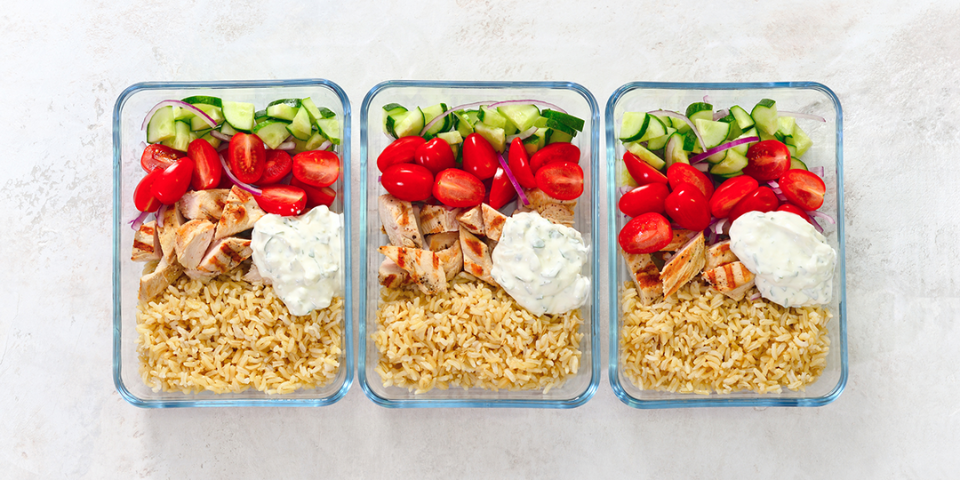
Perhaps you find cooking a rewardless chore. Or maybe strict eating habits serve your goal of a fitter, leaner body. As distinctly different as these two types may seem, many people within each have adopted the same strategy: Eat the same thing every day.
But can you really repeat the same food every day — or at every meal — and provide your body the most complete nutrition possible?
Eating the Same Thing for Every Meal: Good or Bad?

Those seeking a specific physical (or fiscal) goal may be tempted to simplify their every meal to a handful of selected foods. But eating the same meal multiple times throughout a day isn’t recommended, says Brittany N. Crim, Ph.D., director of Nutrition Services and Development at the University of Texas at Austin.
“It’s hard to get all your macros and micros in the right proportion on a daily basis,” she says. It’s even harder when you give yourself just one type of meal with which to do it.
If you’re going to “eat the rainbow,” that requires consuming a variety of nutrients that are unlikely to all be represented in a single meal. You may be able to sustain life, the way they do in a clinical setting for people with conditions in which a patient has to be tube-fed for long periods, but you won’t be thriving. And on a long enough timeline you’re bound to experience deficiencies that may cause serious problems down the road.
“We’re inserting the same macronutrients and micronutrients in tube form, and sustaining life and health that way,” says Crim. “So, yes you could eat the exact same thing all day, every day, as long as it was perfectly balanced with all the macros and micros that you need. Would I recommend that for people? No.”
Eating the Same Meal Once Every Day: Good or Bad?

You can, however, follow a diet wherein you eat the same meal at some point every day, which is what most people do for breakfast or lunch, Crim says.
“I don’t eat red meat every day, but that’s my primary source of iron,” she says. “And I get enough iron for my week when I eat red meat, two servings a week.” So if you eat the same breakfast every day, mix it up at lunch and dinner and with snacks.
The bottom line is that any eating plan that doesn’t provide all of the nutrients you need on a daily basis can have damaging consequences. As can getting too much of a given nutrient from overeating even “healthy” foods. For example, consuming too many carrots can turn your skin orange.
Here are the upsides and downsides of keeping one meal the same every day:
Pros
- Easier to keep track of calories
- Less time making shopping and cooking decisions
- Easier to establish healthy eating habits
Cons
- May result in nutritional deficiencies
- May result in too much of a given nutrient
- Taste fatigue can discourage you from eating all or any of a meal, resulting in wasted food and money
Having the flexibility to rotate at least a few of your meals is important in the long run. Better still is planning a menu of meals for the week, which provides some of the conveniences of meal simplification while offering a fuller nutrient profile.
Can Supplements Make Up for Nutritional Gaps?

But, you may say, I’m able to pop a few multi-vitamins and some fish oil every day, so my repetitious, and potentially detrimental, meal won’t matter that much. Not so fast.
Dietary supplements, though they do offer benefits if you are deficient in a certain vitamin or mineral, should not be used as a panacea.
“I’m a firm believer in trying to eat your nutrients. We can supplement, but it’s not going to be as effective as if you actually ate the food,” Crim says. “Food actually gives you more bioavailability of a nutrient so you’re more likely to intake it and absorb it and utilize it effectively.”
Most micronutrients work synergistically, which means if you get them from a variety of sources, they’re going to enhance their ability to work throughout the body and enhance their longevity in your system. “So taking one supplement may not be as beneficial as eating a big, beautiful salad that has 15 different varieties of antioxidants in it.”
